
The Snow Leopard & Ladakh
How a high, cold desert became the Snow Leopard Capital of the World.
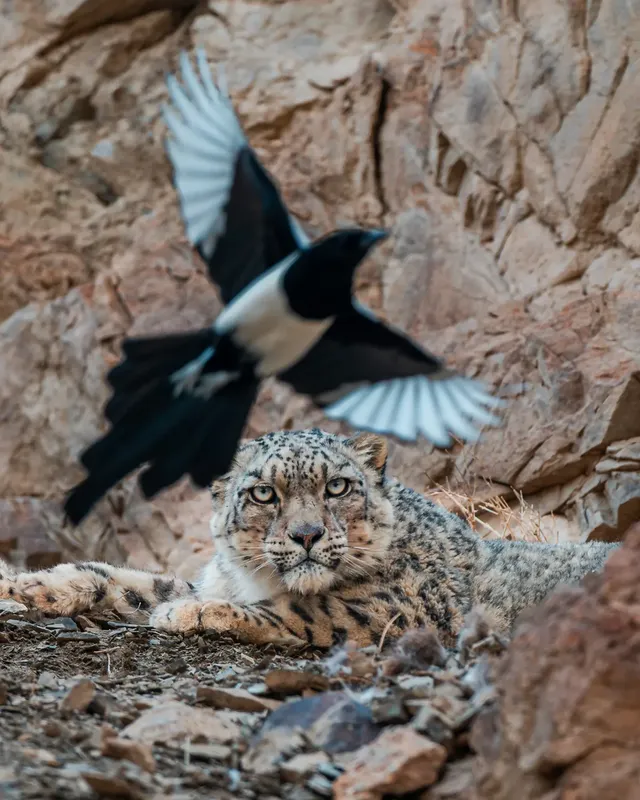
Resting on a cliff ledge, Ladakh. Photograph: Karanjit Singh.
A cat made of rock and snow
The snow leopard (Panthera uncia) lives in the high mountains of Central and South Asia, usually between 3,000 and 5,500 metres. Its smoky-grey coat, broken with dark rosettes, disappears against rock and snow. Its tail, almost as long as its body and thick with fur, balances it on steep slopes and wraps around its face against the cold.
It is a solitary, mostly silent cat. It hunts along ridgelines and cliff edges, where its main prey, the blue sheep (bharal) and the Asiatic ibex, graze. In winter, when the prey moves down to lower slopes, the snow leopard follows. That is why winter is the season to search for it.
The world's densest snow leopard country
Source: Snow Leopard Population Assessment in India (SPAI) 2019–2023, as cited in LADAKH: Snow Leopard Capital of the World.
Thirty years that changed a valley's mind
For generations, a snow leopard that broke into a livestock pen could kill many animals in one night, and some were killed in return. Over three decades, that changed. Hemis National Park was managed as a stronghold for the species. Families built predator-proof corrals. The Himalayan Homestay programme, begun in 2002, let villages earn from visitors who came to see the cat. Today more than 200 homestays in over 40 villages share in that income, and retaliatory killing has almost ended in the villages that take part.
Ladakh's Buddhist tradition of respect for living beings made that change possible. The work of wildlife officers, scientists and communities made it last.
Read the full story in the bookNot alone in these mountains
The snow leopard shares these mountains with the Tibetan wolf, the Eurasian lynx, the red fox, the Ladakh urial and the Asiatic ibex; with lammergeiers and golden eagles overhead; and, on the Changthang plateau, the Pallas's cat, the kiang and the black-necked crane.
The Grand Expedition- Free-roaming dogs, which hunt wild prey, spread disease and compete with native predators
- Disturbance, including crowding, off-road driving and baiting by irresponsible tourism
- Climate change, altering snow, grazing and prey across the high mountains
- Loss of tolerance, if the benefits of coexistence stop reaching the villages